An agency might run GEO work for 10 to 20 client brands at once, each with its own competitors, markets and goals. An in-house team usually works on one company, but that company may have several brands, product lines and regions to study over time.
Both need to know how AI assistants understand and recommend their brands. They do not need exactly the same things from a GEO tool. Our view: the two rarely need completely different platforms. What matters is whether a tool fits how each team manages work, collaborates and measures results.
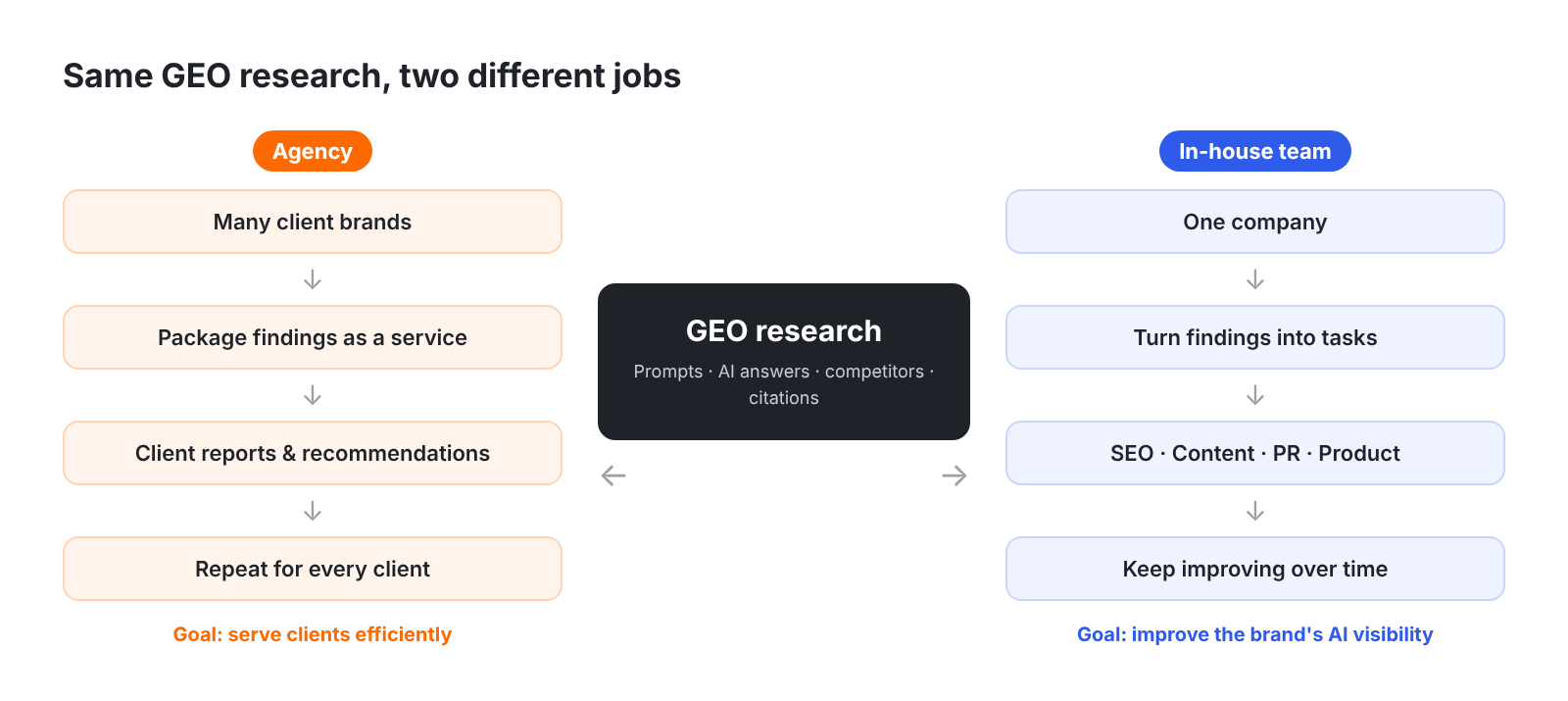
Figure 1: The same GEO research leads to different work for an agency and an in-house team.
TL;DR: Agency vs In-house GEO Tools at a Glance
Dimension
Agency
In-house
Main goal
Deliver GEO services to many clients
Improve AI visibility for its own brand
What it manages
Many unrelated client brands
One company, often with several brands
Prompts and competitors
A separate set for each client
Long-term sets built around one market
Reporting
Client reports, share links, white label
Internal dashboards and management summaries
Who uses the tool
Account managers, SEO specialists, clients
SEO, content, PR, product marketing, leadership
Cost focus
Cost per client
Depth of analysis and long-term cost
Treat this as a tendency, not a rule. A company with several brands may need workspace management as complex as an agency's, and an agency with one large client may need in-house depth.
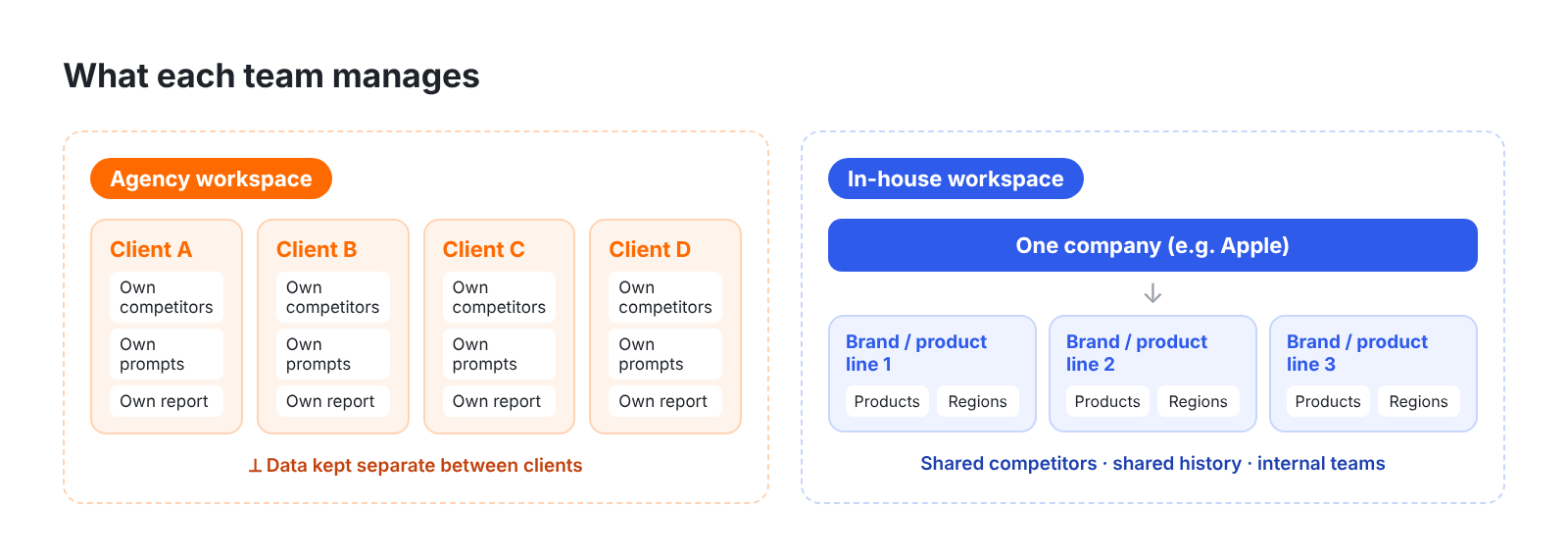
Figure 2: An agency manages many separate clients; an in-house team manages one company with many brands and products.
What GEO Tools Measure, and How It Differs from SEO
A GEO tool sends prompts to AI assistants and records the answers: whether your brand is mentioned or recommended, which competitors appear, which pages are cited, and how this changes across models, regions and time.
AI answers are not stable. The same prompt can produce a different answer an hour later or on another model, so one answer is a sample, not a ranking. Repeated monitoring and access to the underlying answers matter more than any single snapshot.
GEO and SEO are complementary. Pages that rank well often feed AI answers, but an AI mention is not a Google ranking, a cited page is not a backlink, and the two should be reported separately.
What Agencies Need from a GEO Tool
Separate workspaces for each client. Each client needs its own brand, competitors, prompts and regions, with data kept apart and a portfolio view across all of them. Check early what the tool counts as a "project": a single brand or a whole company. That decides how many clients a plan really covers.
Fast, repeatable onboarding. Templates, bulk prompt editing and preserved history shorten the time from signed contract to first insight.
Client-ready reporting. Share links, PDF export, scheduled reports, white label and client portals are different features. Ask exactly which ones are included and on which plan.
Per-client usage and cost control. Know how prompt, model and region quotas are split across clients and what happens when you exceed them.
Findings you can explain. Why is a competitor recommended instead? Which content gaps or cited sources matter? What should the client fix first? A visibility score alone does not answer these.
What In-house Teams Need from a GEO Tool
Depth on one market. Brand positioning, product selling points, buyer intent, segments, and how AI describes the brand.
History. In-house teams watch the same competitors and category for a long time, so trends matter more than snapshots.
Cross-team collaboration. GEO fixes are usually shared: SEO owns crawlability and page optimization, content fills gaps, PR works on third-party sources, product marketing owns product facts. Findings need to be easy to share and assign.
Connection to existing data. Search Console, GA4, BI tools and a CMS. Ask whether an "integration" is native, an API you build against, or a manual export.
Careful links to business outcomes. More AI mentions do not automatically mean more revenue, and AI referral traffic is hard to attribute. Report it as a relationship you are tracking, not one you have proven.
What Happens After You Find a Visibility Gap
Take one common problem: when users ask AI for product recommendations, a competitor keeps replacing the brand.
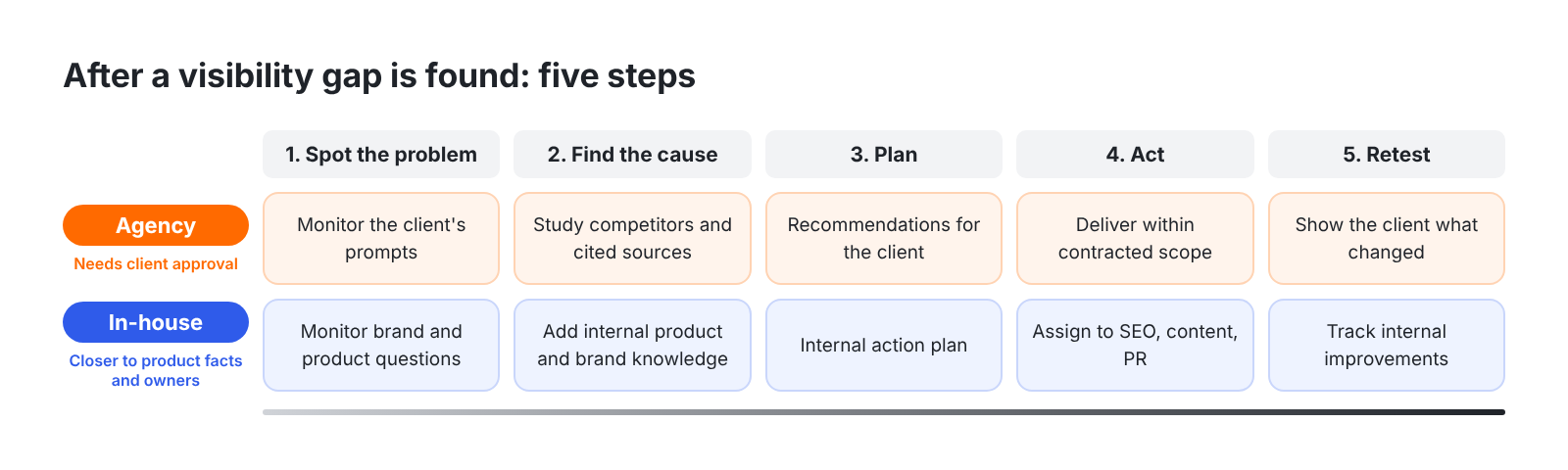
Figure 3: The same visibility gap, handled by an agency and by an in-house team.
An agency monitors the client's prompts, studies competitors and sources, turns the findings into recommendations, delivers within the agreed scope and shows the client what changed. An in-house team adds its own product and brand knowledge, builds an internal plan, assigns work across teams and keeps tracking the effect. The agency needs client approval at each stage; the in-house team is closer to the people who can make changes. What matters is whether the tool supports every step.
How to Evaluate GEO Tools
Score each tool from 1 to 5 on each dimension, then weight the scores. The weights below are our suggested starting point, not a rule.
Dimension
Suggested weight: agency
Suggested weight: in-house
Multi-model coverage
High
High
Prompt management
High
High
Multiple brands and workspaces
Very high
Medium to high
Citation and competitor analysis
High
High
White-label reporting
Very high
Low to medium
Internal collaboration
Medium
Very high
API and data integration
Medium to high
High
Cost control
Very high
High
Then test before you buy:
Test at least two clients, or two product lines and regions, not one easy case.
Check that every metric traces back to the original AI answer, cited URLs, prompt, model, region and date.
Build one real client report or leadership summary, and time it.
Check permissions, read-only access, data export and what happens to the data when someone leaves.
Calculate the full cost at your real scale.
Dageno: GEO/AEO Market Intelligence for Agencies and In-house Teams
Dageno is a GEO/AEO platform for brand, SEO, growth and content teams. It helps teams see how AI understands them and their competitors, and decide what to fix first. Agencies and in-house teams work differently, but both need to know how AI understands a brand, why it recommends a competitor, and which information and sources shape that judgment.
Start with the Market, Not Just Prompt Counts
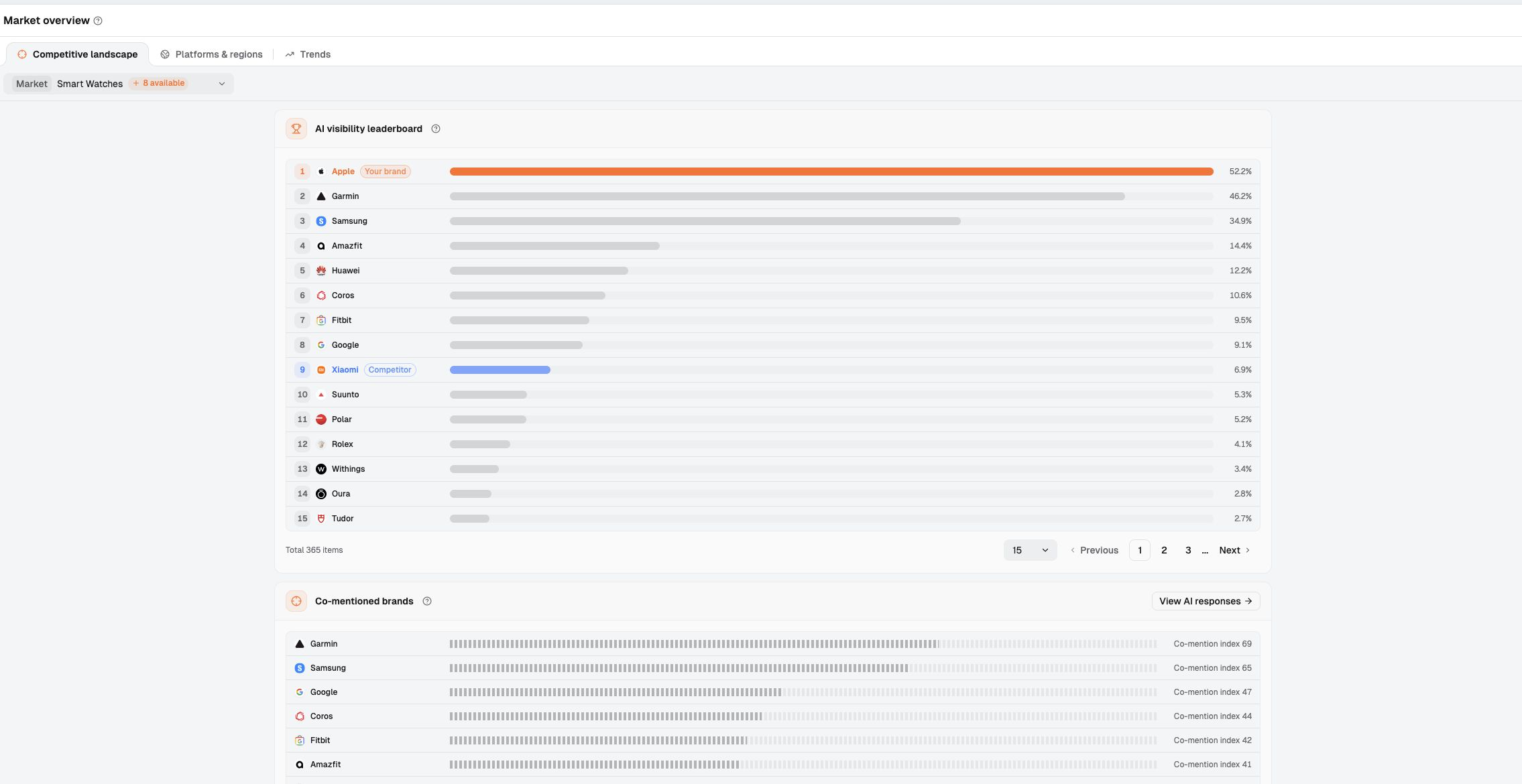
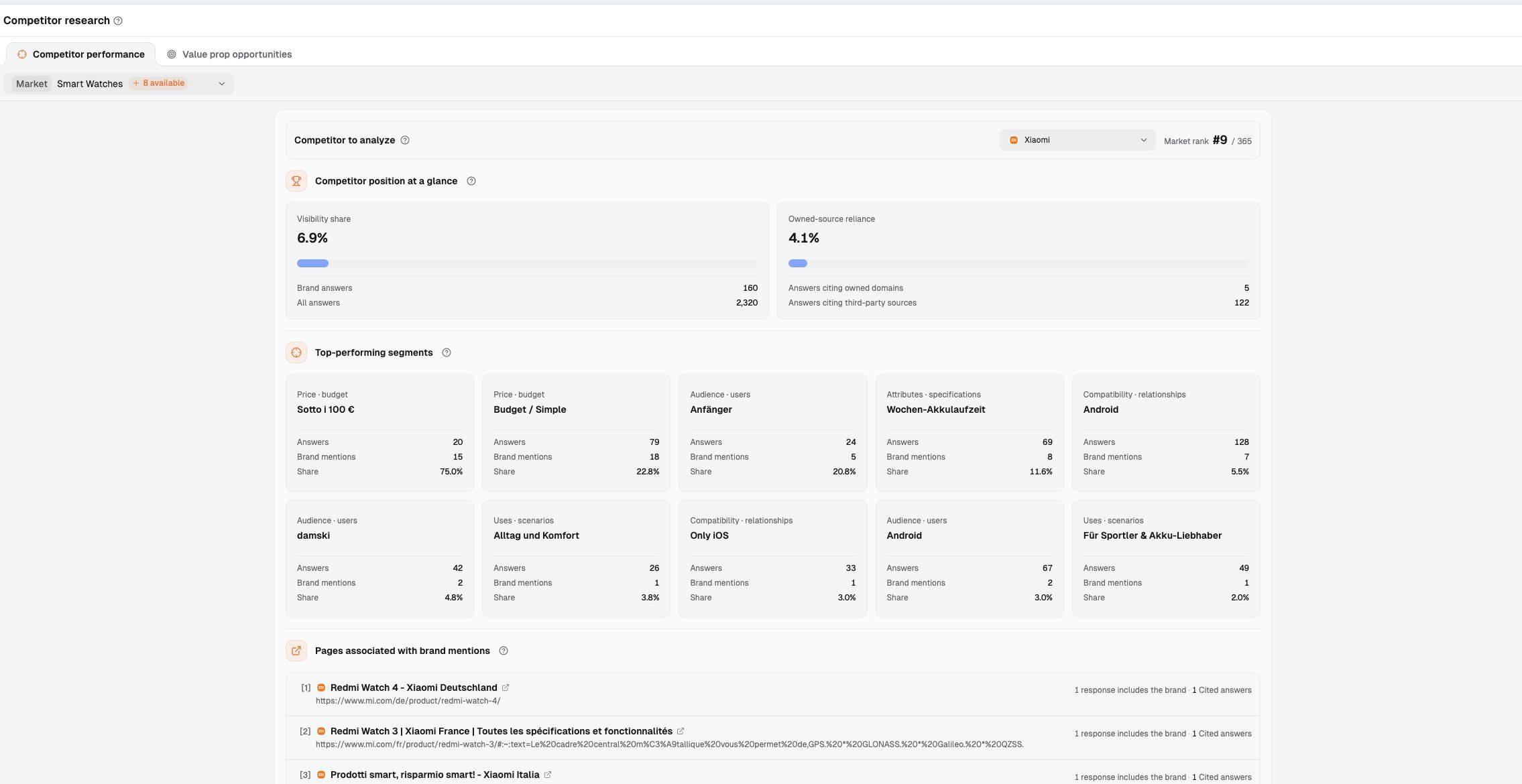
Dageno's Market Intelligence 2.0 covers Market Competitive Landscape, Market Segments, Search Intents, Competitor Research and Brand Value Props. An agency can use it to understand a new client's market, competitors and user intents before writing recommendations. An in-house team can use it to keep watching its own segments and competitor moves.
Figure 4: Market overview. Which brands AI surfaces in the smart watch market, and how visibility is split.
Figure 5: Competitor research. Xiaomi's visibility share, source reliance and strongest buying situations, viewed from Apple's workspace.
See How AI Connects Brands, Claims and Sources
The Brand Graph connects companies, brands, products, intents, value propositions, sources, platforms, regions and time, so you can see whether AI links a brand to the right products and claims.
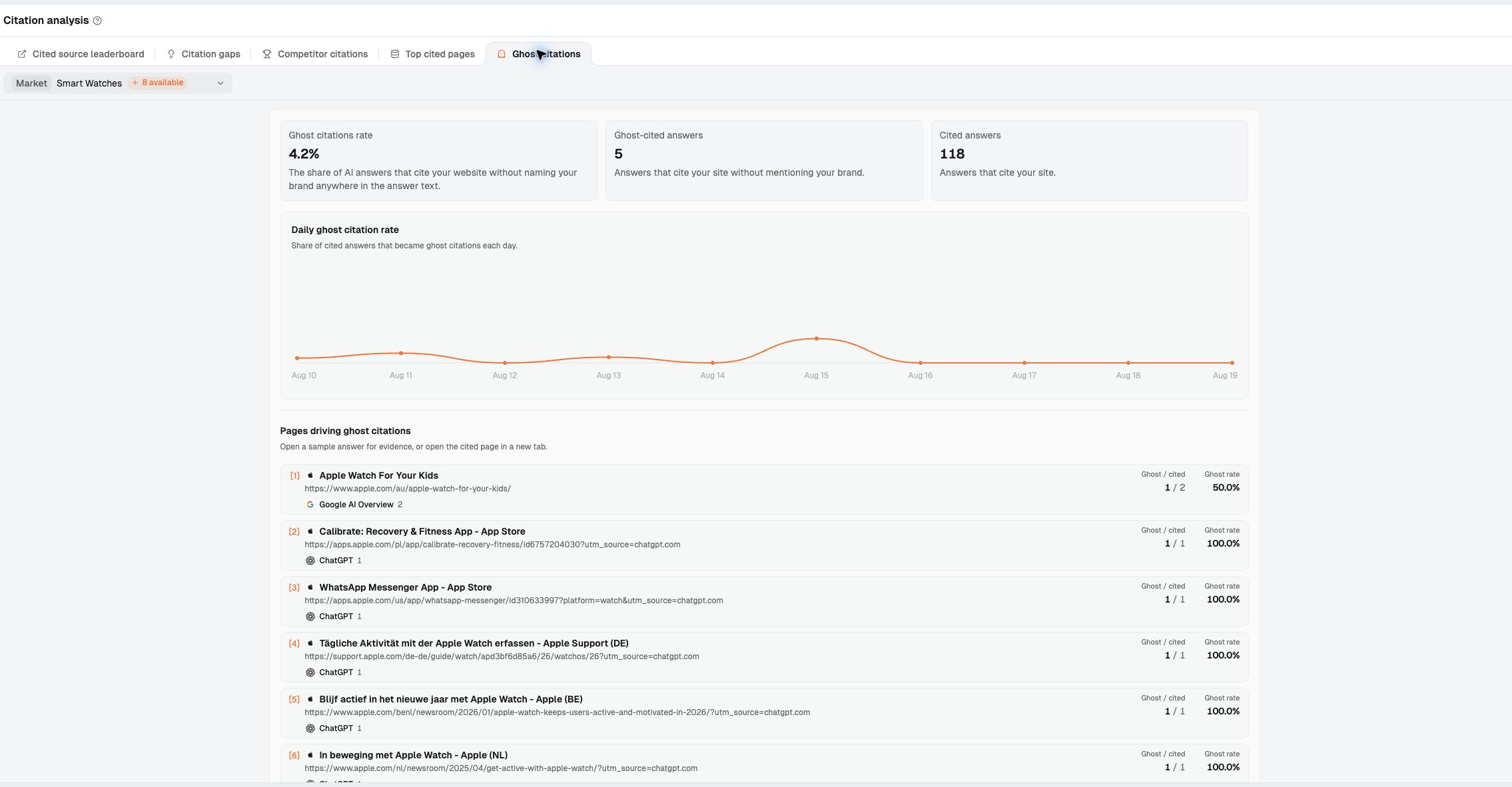
Citation Analysis shows which pages AI cites. Ghost Citations show where AI cites your site without naming your brand: your page supplies the answer, but the brand gets no credit. You can open the original answer and cited page to check the evidence.
Figure 6: Ghost citations. Pages AI cites without naming the brand.
Compare Across Models and Regions, with Organic Search Context
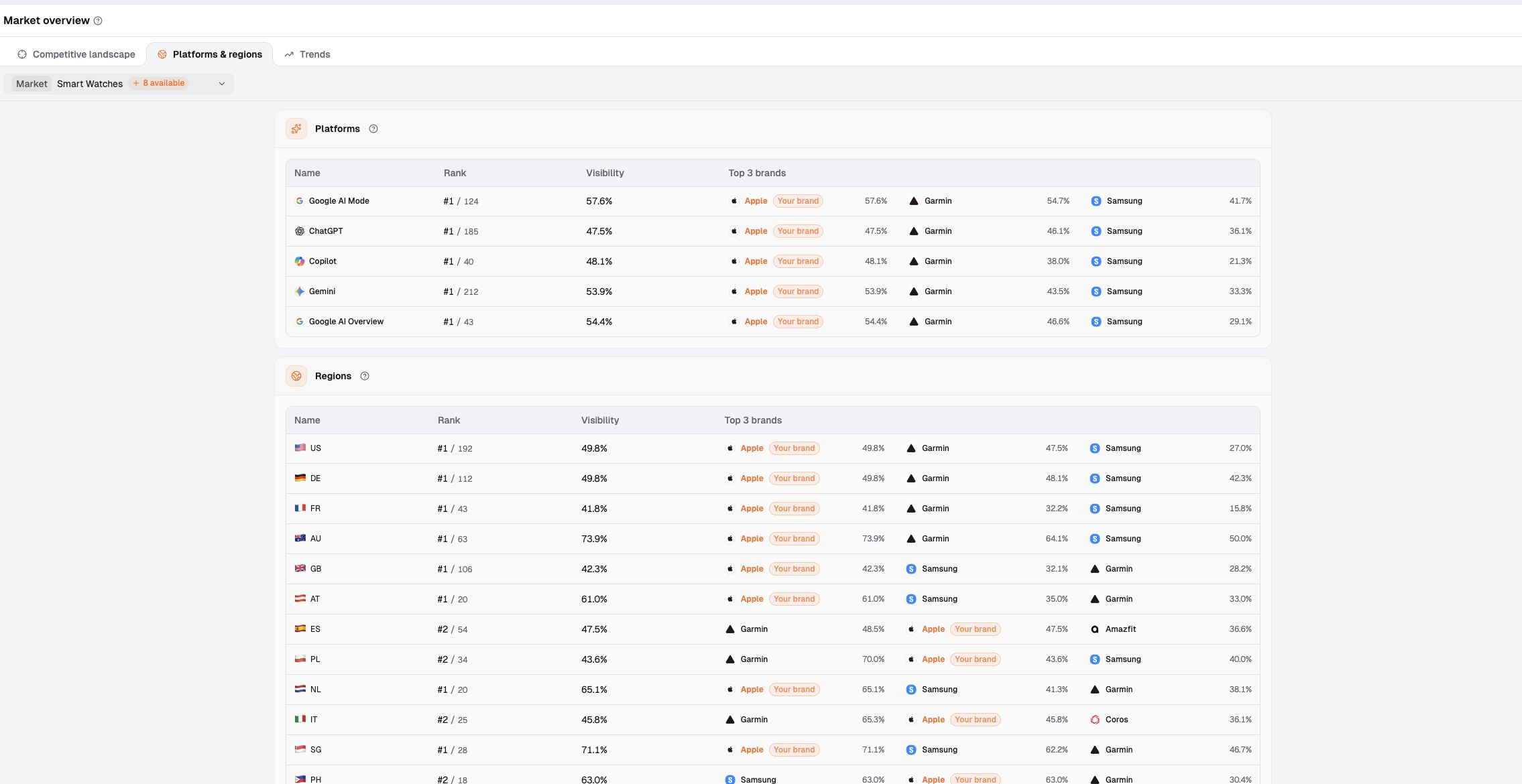
Dageno tracks 9 standard AI platforms across 86+ countries and regions, so a brand's position can be compared by platform, region and intent. An Organic Search view sits in the same project. Read it alongside your own Search Console and GA4 data, but keep the metrics apart: AI mentions, search clicks and conversions are different things.
Figure 7: Brand position compared by AI platform and by region.
Pricing and Fit
Public market queries in Dageno are free, permanently, so a team can look at its market or a prospect's brand before buying. Every paid plan includes all 9 standard AI platforms and 86+ regions.
Plan
Monthly price
Projects
Prompt quota
Starter
$49
1
50
Growth
$199
2
250
Scale
$410
5
600
Custom
Custom
Custom
Custom
One project is one company, such as Apple, with all its brands and products. An in-house team usually needs one project; an agency usually needs one per client company, so agencies with more than five client companies will need a Custom plan. The prompt quota is shared across projects, and the same prompt on different platforms or regions counts separately.
Dageno fits agencies adding GEO/AEO services, in-house SEO and content teams studying their brand in AI answers, and growth teams that want search and AI search together. Agencies that want a formal partnership can look at the Partner Program; white label is discussed case by case. For rank tracking or technical crawling, you still need a traditional SEO tool.
Compare the Same Workload, Not Starting Prices
Scenario
Monitoring scale
Main cost questions
Agency
10 clients, 20 prompts each
Client separation, separate competitor sets, reporting
These are examples of how to calculate cost, not real plan prices. Both have 200 prompts, but the agency needs 10 separate projects and the in-house team needs one deep one. If each prompt runs on 3 platforms in 2 regions, 200 prompts become 1,200 units of usage in a tool that counts each combination. Before you compare, also check workspace fees, brand limits, refresh frequency, export limits and overage charges.
See how AI understands your brand, or your client's
FAQs About GEO Tools for Agencies and In-house Teams
Can an agency and its client share one GEO platform?
Yes, and it often prevents conflicting numbers. Use one set of prompts, models, regions, time ranges and retest frequency. Agree who creates and edits prompts, whether the client has read-only access, and who keeps the prompts, history and reports when the contract ends.
Do agencies always need white-label reporting?
No. It matters most for agencies that sell GEO under their own brand or give clients direct access. Agencies that build their own reports from exported data may not need it.
Is prompt volume a good way to compare tools?
Not on its own. 200 prompts for one company and 200 prompts across 10 clients need different workspaces, competitor sets and reports. Also check whether models and regions multiply usage.
Is one brand one simple workspace?
Rarely. One company can have many products, countries, audiences and business lines. A flat setup will miss the differences between them.
Do GEO tools track citations as well as mentions?
Many do, but check. A page can be cited while the brand is not named. Brand mentions, page citations and Google rankings are three different metrics; report them separately.
Can GEO tools replace traditional SEO software?
No. GEO tools measure AI answers. You still need SEO tools for rank tracking, backlinks and technical crawling.
Final Verdict: Choose Around How Your Team Works
Agencies usually care most about separate client data, fast onboarding, client reporting and cost per client. In-house teams usually care most about depth on their own brands, competitor history, cross-team collaboration and connecting GEO to existing data. Choose on real workflow, permissions, evidence quality and total cost at your scale, not on a product label or the lowest starting price.
If you want to understand how AI sees your brand and your competitors, and decide what to fix next, Dageno is built for that, whether you run an agency or an in-house team.
About the Author
Updated by
Dageno
Dageno is the research and insights team at Dageno AI, publishing industry reports and expert analysis on AI Search Visibility, Generative Engine Optimization (GEO), and AI-powered search discovery.
 Alexa (Custom plan)