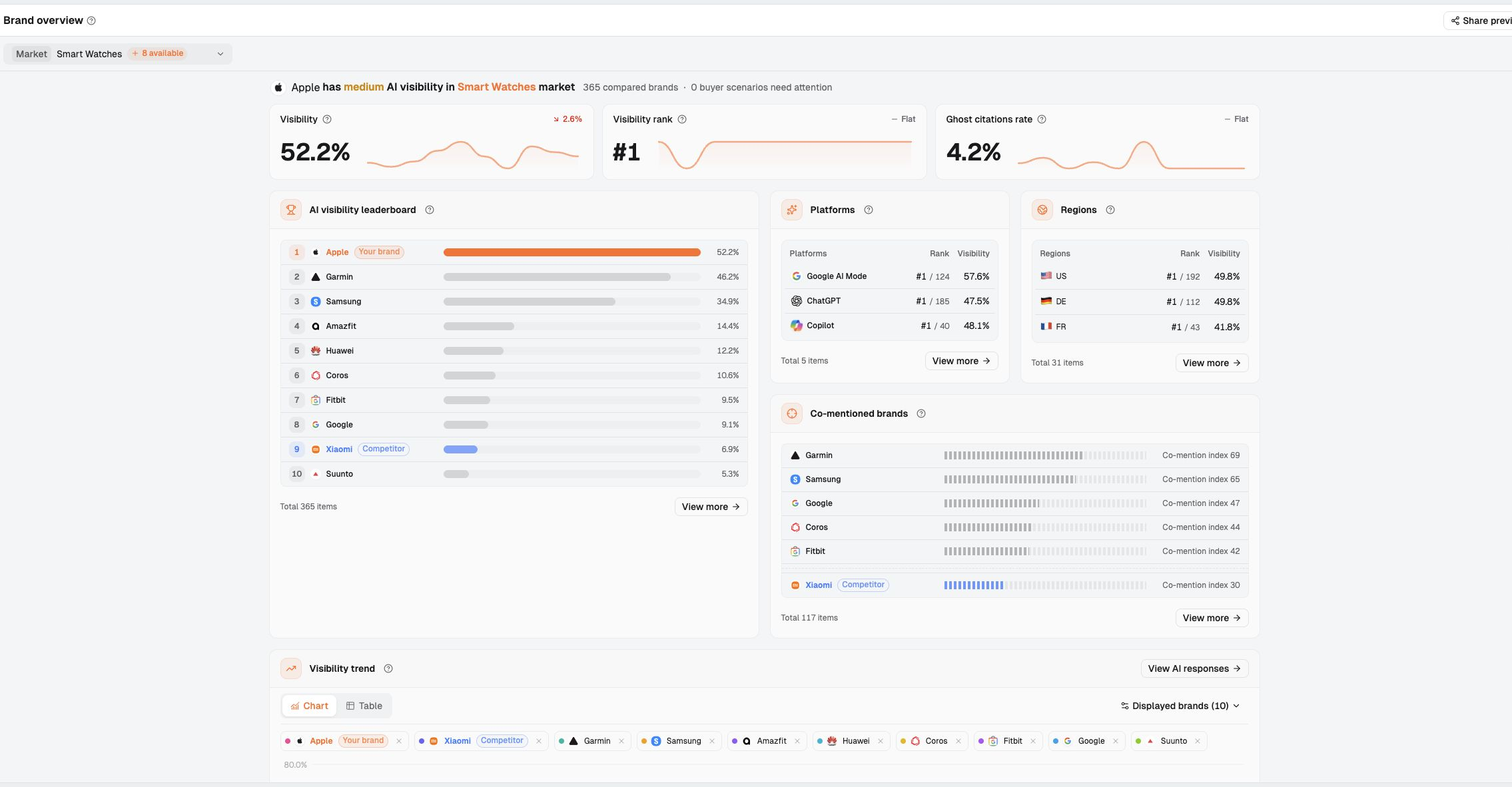
Article summary: LLM Visibility Tools not only help businesses understand whether their brand appears in AI answers on ChatGPT, Gemini, Perplexity, and other platforms, but can also track competitors, citation sources, and the scenarios in which brands get recommended. This article compares seven tools, Dageno AI, Profound, Peec AI, Otterly AI, Semrush, Ahrefs Brand Radar, and Scrunch AI, and covers their use cases, selection criteria, and how to identify optimization opportunities from visibility data.
Quick takeaway: If you only need to regularly track brand mentions for a set of Prompts, start by testing Otterly AI or Peec AI; if you already have a mature SEO workflow, evaluate Semrush and Ahrefs Brand Radar; large enterprises can focus on Profound and Scrunch AI. If you want to go further and understand why the AI recommends competitors, which brand relationships and citation sources that recommendation is based on, and discover opportunities across the whole niche market, Dageno AI is worth evaluating closely.
1. The 7 best LLM visibility tools in 2026: quick comparison
Tool
Better-suited team
Main evaluation value
What to verify before purchasing
Dageno AI
Brand, growth, and agency teams that need AI search market intelligence and brand competitive analysis
Target market coverage, data update cadence, project monitoring and report permissions
Profound
Organizations that need enterprise-grade AI search analytics
AI answers, brand performance, and citation research
Procurement cost, organizational permissions, data granularity
Peec AI
Marketing teams that value brand and competitor visualization
Prompt monitoring, competitive performance, citation and trend analysis
Models, regions, export, and reporting features
Otterly AI
Small teams that want to start AI monitoring quickly
Tracking of prompts, brand mentions, and link citations
Monitoring quotas, frequency, and scalability
Semrush
Teams already using traditional SEO tools
Combines AI search insights with existing SEO research
Which product and plan the AI features you need belong to
Ahrefs Brand Radar
Teams that need to combine search, web page, and brand research
AI brand exposure and broader search data analysis
Data sources, regional coverage, and billing method
Scrunch AI
Enterprises that care about how AI presents brand information
AI brand representation, sources, and related governance analysis
Product modules, implementation requirements, and available features
Ask one question first when choosing: are you trying to solve "does the brand appear?" or "why does the AI recommend others instead of me?" The former mainly needs ongoing monitoring; the latter requires connecting markets, brands, products, user intents, and evidence sources in the analysis.
2. What is LLM Visibility Tracking?
LLM Visibility Tracking means observing, around specific user questions, how a brand, product, or website is mentioned, recommended, cited, and compared in AI-generated answers, and measuring it repeatedly under relatively consistent conditions.
For example, a B2B SaaS company can monitor:
"What are the best project management tools for mid-sized companies in 2026?"
"Which products offer automated approvals and permission management?"
If the AI repeatedly recommends competitors on these questions and doesn't mention your product, a traditional Google ranking report can't fully explain the gap.
How does LLM visibility differ from traditional SEO rankings?
Dimension
Traditional SEO rankings
LLM visibility tracking
What is observed
Search results and web pages for keywords
Brands, products, sources, and recommendations in AI answers
Core unit
Keyword, URL, ranking
Prompt, answer, brand, citation, model, market
Competitive question
Who ranks higher in search results
Who gets recommended by the AI, why, and what is cited
Main metrics
Rankings, impressions, clicks, CTR
Mention rate, recommendation rate, Share of Voice, citation visibility
Basis for optimization
Page content, technical SEO, links, and relevance
Brand entity information, user intent, evidence sources, and market gaps
The two kinds of data should be used together, not as substitutes. Google Search Console tells you how many impressions and clicks a web page gets in traditional search; LLM visibility tools complement it by answering how the brand is understood and presented in AI-generated answers.
Important limitation: No monitoring tool can directly read all users' private conversations with platforms such as ChatGPT. Their visibility metrics are usually based on preset questions, publicly available or accessible AI answer samples, and their own statistical methods. So results should be understood as "performance under specific monitoring conditions," not as the absolute truth of the entire AI search market.
3. 8 criteria for evaluating LLM Visibility Software
1. Does it distinguish brand mentions from explicit recommendations?
"A product exists in the market" and "a product is worth buying" are not the same thing. The tool should, as far as possible, distinguish plain mentions, explicit recommendations, negative descriptions, and incorrect attributions.
2. Can you view the original AI answers?
A Visibility Score alone isn't enough. Ideally you can look back at the Prompt, answer text, collection date, platform, region, and citation links to verify that the statistics are accurate.
3. Can it identify real competitors in AI search?
Competitors in the Google SERP aren't necessarily the main competitors in AI recommendations. Check whether the tool can discover brands that repeatedly appear together under the same user intent.
4. Does it support Search Intents analysis?
A brand may have high exposure on "what is" questions yet be absent from high-purchase-intent questions such as "best tools," "alternatives," and "price comparison." Analyzing by user intent has more actionable value than looking only at the total number of mentions.
5. Does it provide specific citation evidence?
It should be able to answer which URL the AI cited, whether the source is the official site or a third party, and how the source relates to the brand recommendation. Citing a web page isn't the same as recommending the brand that owns it, and the two metrics must be kept separate.
6. Can it compare across platforms, regions, and languages?
ChatGPT, Gemini, Perplexity, and other products differ in how they produce answers and cite sources. When purchasing, verify the models, regions, languages, and sampling frequency against your own target markets.
7. Can monitoring be extended into market intelligence?
Beyond fixed Prompts, can it study the brand landscape, product selling points, competitive relationships, and newly emerging purchase intents across an entire niche market? This determines whether a tool is a monitoring dashboard or a research platform that can support strategic decisions.
8. Is it suited to real team delivery?
For enterprises and agencies, you also need to consider multi-brand management, reporting, logo customization, permissions, export, historical comparison, and cost. Don't mistake "supports branded PDFs" for "supports a full white-label SaaS platform."
4. The 7 LLM visibility tools in detail
1. Dageno AI: for teams that want to understand AI recommendation relationships and the market competitive landscape
Best for: Brand marketing, SEO/GEO, growth, and competitive research teams, as well as agencies that need to explain AI search competitive dynamics to clients.
Dageno 2.0's core positioning is AI Search Market Intelligence and a GEO/AEO platform. It doesn't only observe whether a brand appears in AI answers; it also helps teams understand how the AI understands a market, which brands hold the recommendation positions, what users are comparing, and which relationships and evidence a brand lacks to support a recommendation.
Core differentiator: use the Brand Graph to understand why the AI recommends them instead of me
An AI's recommendation of a product may involve several factors at once: which company owns the brand, which products the brand offers, which needs the products meet, which sources have described the relevant selling points, which organizations or media provided evidence, and on which platform, in which region, and in which time period this information appears.
Dageno uses a Brand Knowledge Graph to link companies, brands, products, organizations, user intents, selling points, sources, AI platforms, regions, and time. Teams can go from a one-off "was it mentioned?" to "is the evidence chain complete for the brand in a given purchase scenario?"
Here's an example: a project management SaaS finds that a competitor appears frequently on the question "project management tools for the financial industry." Looking only at mention rate would yield the conclusion that "the competitor leads"; combining the Brand Graph and citation sources, you can investigate further: does the AI associate the competitor with features such as financial compliance, permission control, and customer cases? Do those associations come from official product pages or third-party reviews? On which relationships is your own brand not clearly identified?
This analysis doesn't mean it can precisely reveal the model's internal causal mechanisms, but it can provide verifiable market evidence and priority directions for investigation.
Main product capabilities
AI Search Market Intelligence: Observe the brand competitive landscape starting from a niche market, rather than only analyzing a few Prompts filled in beforehand.
Brand Explorer: View the AI search performance of the target brand and other brands in the same market, and carry out side-by-side competitive research.
Brand Knowledge Graph: Link brands, products, selling points, user intents, and citation sources to help understand AI recommendation relationships.
Search Intents: Study how users discover, compare, and choose products, and identify scenarios that have commercial value but where the brand is absent.
Citation Intelligence: Analyze the sources cited in AI answers, distinguish brand mentions from URL citations, and trace the related evidence.
Topic & Prompt Tracking: Continuously monitor custom topics and questions, and compare changes for the brand and its competitors.
AI Shopping & Ads Intelligence: Provide supplementary research on the product and advertising dimensions for relevant commercial markets.
Brand Reports: Combine the market perspective with the project Prompt monitoring perspective, to explain competitive position, gaps, and next priorities to management or clients.
Dageno's data foundation covers about 12,000 niche markets, over 100 million product records, and over 500 million ad records. These are the scale figures from the product materials and shouldn't be understood to mean that every region, brand, or platform has the same depth of real-time data.
Start from public market research, rather than buying a plan first
Dageno's product policy emphasizes "data first, pricing later": public market lookups are free forever. According to the plan description provided, from Starter you can choose the standard 10 models and 86 countries and regions; the specific quotas, update frequency, and available scope should still follow the current product interface and terms.
This is especially valuable for teams still evaluating GEO investment: first observe your own market and competitive landscape, and then decide whether to set up ongoing Prompt monitoring or client reporting workflows.
Strengths and things to note
Why it's a good fit: What sets Dageno apart is that it understands brand exposure within a larger context of markets, user needs, and evidence relationships. For teams that want to answer "what should we fill in next?" rather than just "what's this week's mention rate?", market intelligence and the Brand Graph are especially worth evaluating.
What to verify: The depth of data coverage in specific markets, the sampling methods for different models, historical data, project quotas, and reporting features. The Brand Graph provides relationships and evidence that can be analyzed, and it can't guarantee a definitive explanation of the internal causal mechanisms behind AI recommendations; nor can using it guarantee that brand rankings or recommendation rates will necessarily rise.
Suggested first step: On the Dageno website, view the public information for your target market, first find the main competitors, user intents, and citation sources, and then decide whether to set up ongoing monitoring.
2. Profound: for organizations that need enterprise-grade AI search intelligence
Profound suits teams that want to fold AI search into enterprise brand research, market analysis, and organization-level reporting. When evaluating, you can focus on AI answer analysis, brand and competitor comparison, citation sources, team collaboration, and enterprise-grade data management.
Best-fit scenario: A large enterprise wants to build an ongoing AI search observation system across brands and teams.
Main strengths: Better suited to bringing AI search data into mature enterprise analysis workflows, rather than being just a lightweight tracking tool for individual use.
Verify before purchasing: The actual feature modules, pricing, model and region coverage, history retention, raw data export, permissions, and implementation cost. You can't infer from a product's enterprise positioning that all modules are included in the standard plan.
3. Peec AI: for marketing teams centered on brand and competitor visibility reports
Peec AI suits marketing teams that need to observe visibility changes by prompt, competing brand, and AI platform. Its value lies in helping teams intuitively understand where the brand appears, how competitors perform, and which sources are cited.
Best-fit scenario: Regularly reporting brand AI exposure, competitive changes, and monitoring results to a CMO or clients.
Main strengths: Centered on visibility analysis and competitive comparison, making it easy to establish repeatable monitoring and communication workflows.
Verify before purchasing: Whether it supports your target platforms, countries, and languages; Prompt grouping and customization; source URL granularity; report and export permissions. Peec's product scope may keep expanding, so it can't simply be described as "monitoring only."
4. Otterly AI: for small teams that want to launch Prompt monitoring quickly
Otterly AI is a lightweight AI search monitoring option worth evaluating, especially for teams that want to track brand mentions and link citations around a set of fixed questions.
Best-fit scenario: Small SaaS companies, consultants, or agencies first validating whether AI search is worth treating as a separate long-term monitoring project.
Main strengths: Uses Prompt tracking as the entry point, making it easy to build a baseline and run regular reviews around fixed questions.
Verify before purchasing: Prompt quotas, monitoring frequency, available platforms, countries and languages, historical data, and multi-client reporting capability. For complex cross-market competitive research, you need to test in practice whether its analytical depth is sufficient.
5. Semrush: for teams that want to combine AI search with traditional SEO
Semrush's value lies in its traditional SEO research ecosystem. For teams already using Semrush for keyword, competitive, technical SEO, and content research, bringing AI search-related features into the same toolset may reduce some context switching.
Best-fit scenario: SEO teams that want to observe traditional search performance and AI search exposure together.
Main strengths: The potential to connect with existing SEO data and working habits.
Verify before purchasing: Which product module the specific AI visibility features belong to, how they're billed, which platforms and markets they support, and whether you can view original answers and specific citations. Strong traditional SEO features don't automatically mean the most complete capability for analyzing AI recommendation relationships.
6. Ahrefs Brand Radar: for teams that value linking brand, search, and web page data
Ahrefs Brand Radar can be a candidate tool for researching a brand's AI search exposure. For teams that already rely on Ahrefs for search demand, competitor, content, and link research, it's worth evaluating how its brand visibility data fits with their existing research workflows.
Best-fit scenario: Search research teams that want to understand a brand's performance across traditional search, web content, and AI answers at the same time.
Main strengths: Can add a brand AI visibility perspective within a familiar search and content research system.
Verify before purchasing: The supported AI engines, data samples, countries and languages, specific Prompt capabilities, brand alias handling, and subscription cost. Brand exposure data isn't a complete count of all real user questions.
7. Scrunch AI: for enterprises that care about AI brand representation and information accuracy
Scrunch AI is worth evaluating for enterprise teams that care not only about mention counts but also about how the AI understands, describes, and presents the brand. Enterprises can focus on checking its brand representation analysis, information sources, and related optimization and governance workflows.
Best-fit scenario: Brands with multiple products and business lines that want to reduce incorrect information or inconsistent descriptions in AI answers.
Main strengths: Treats the quality of a brand's representation in AI as an important object of evaluation, rather than looking only at a single overall score.
Verify before purchasing: The specific supported product modules, monitoring and governance features, technical integration requirements, permissions, enterprise procurement process, and pricing. The actual availability of different features should be confirmed through a demo.
5. Which key metrics should you track for LLM visibility?
Brand Mention Rate
Formula: Number of valid answers in which the brand is mentioned ÷ total number of valid monitored answers × 100%.
For example, if the same set of questions yields 100 valid answers and 32 of them mention your brand, the mention rate is 32%. If a question is run multiple times, you must decide in advance whether the unit of measurement is the "answer" or the "Prompt," to avoid inconsistent definitions.
Recommendation Rate
An AI merely mentioning a brand doesn't mean it recommended the brand. We recommend recording separately the share of answers that "explicitly list it as an option to consider" or "explicitly recommend" it, and keeping the original text for manual verification.
AI Share of Voice
Used to observe the relative exposure of a brand and its competitors within the same question set. Different tools may use different denominators, brand sets, and weights, so SOV scores from different tools generally can't be compared directly.
Citation Visibility
Record whether the AI cites the brand's official site, competitor pages, or third-party sources. We recommend separately counting the cited domains, specific URLs, and their overlap with brand mentions.
Search Intent Coverage
Divide questions into types such as awareness, feature research, alternatives, comparison, and purchase decision. An overall mention rate may mask clear gaps in high-commercial-value questions.
Entity Accuracy
Check whether the AI associates the brand with the correct company, products, pricing model, target customers, and features. Incorrect information needs to be handled separately from negative sentiment.
Visibility Trend
For the same set of Prompts, try to keep the platform, region, language, sampling time, and statistical method consistent. Observe changes over multiple periods, and don't treat a single answer as a stable ranking.
6. How do you use LLM Visibility Tracking data to discover optimization opportunities?
Step 1: Build a representative Prompt set
Don't just track questions that contain your own brand name. Cover at least category searches, feature needs, competitor alternatives, product comparisons, and purchase decision questions together.
For example, project management software can track questions such as "best project management software," "project management tools for finance teams," "Asana alternatives," and "approval tools for remote teams."
Step 2: Find the brands the AI actually recommends
List together the brands that appear under the same user intent, and distinguish direct competitors, alternatives, and incidental mentions. The actual competitive set in AI search may differ from your original SEO competitor list.
Step 3: Verify brand relationships and citation sources
Study which product selling points, customer scenarios, organizations, and sources competitors are associated with. For a market intelligence tool like Dageno, this is exactly where the Brand Graph, Search Intents, and Citation Intelligence can be used together.
For example, if the AI always associates a competitor with "financial compliance," while your product actually has relevant capabilities too, you should verify whether your official site explains this clearly, whether there is verifiable documentation, and whether credible external sources can support that description.
Step 4: Sort the gaps into different types
Gap type
Typical symptom
Actions to consider
Brand entity gap
The AI confuses the ownership of companies, brands, or products
Improve official site entity information, product structure, and authoritative materials
User intent gap
The brand rarely appears in high-purchase-intent questions
Add product or comparison content that explicitly addresses those needs
Evidence gap
A competitor's selling points are supported by third-party sources
Build verifiable product documentation, cases, and credible external coverage
Citation gap
A web page is cited but the brand isn't correctly identified
Check page titles, main-body descriptions, brand attribution, and content expression
Information accuracy gap
The AI uses outdated features or incorrect positioning
Update authoritative product information and check for incorrect external descriptions
These actions are evidence-based optimization hypotheses, not deterministic manipulation of the AI model's internal mechanisms.
Step 5: Keep monitoring to verify whether there's improvement
Record the Prompts, answers, brand appearances, citation sources, and sampling conditions from before optimization. After updating content or brand materials, keep observing trends over multiple rounds under the same conditions. Visibility changes may be affected by model updates, retrieval changes, and randomness, and not every change should be attributed to a single content edit.
7. What additional factors matter for enterprise-grade LLM Visibility Tracking?
The needs of large enterprises differ markedly from those of individual site owners. Beyond basic mention rate, you should also consider multiple brands, multiple markets, cross-team collaboration, data permissions, original-answer auditing, report consistency, and long-term repeatability.
You should particularly verify the following questions:
Can you split analysis by country, language, product line, and business unit?
Does it support aliases, sub-brands, and multiple products for the same brand?
Can you trace back to the original answers, citation URLs, and sampling times?
Can you combine market-level research with custom Prompt monitoring?
Does it support management reports, client reports, and data export?
Do the data collection method, retention period, and permissions meet the company's internal requirements?
If the team's main issues are market competitive position and growth opportunities, focus on evaluating the market research capabilities of Dageno, Profound, and similar tools; if the main task is brand representation quality and governance, include Scrunch AI in your key tests; and if you want to combine with existing SEO data, Semrush and Ahrefs are worth comparing.
8. A 30-day tool selection and validation plan
Phase
Suggested tasks
Deliverable
Days 1–7
Determine 30–50 representative Prompts, competing brands, target regions, and platforms
A unified test sample and baseline
Days 8–14
Use the candidate tools to observe brand mentions, recommendations, citations, and original answers
A comparison of how verifiable each tool's data is
Days 15–21
Analyze competitive gaps by user intent and verify 5–10 important sources
An actionable list of opportunities
Days 22–30
Evaluate reporting, permissions, quotas, data export, pricing, and team collaboration
A purchase decision and follow-up monitoring plan
We recommend making "explainability, data evidence, target market coverage, and team usage cost" formal scoring dimensions, rather than comparing only the overall visibility scores in product marketing.
9. FAQ
1. What is the best LLM Visibility Tracking Tool?
There is no single answer that fits every business. For lightweight Prompt monitoring, you can evaluate Otterly AI and Peec AI; if you already have an SEO system, you can evaluate Semrush or Ahrefs; for enterprise research, you can evaluate Profound; and if you need to understand the brand graph, market competition, and recommendation evidence, you can focus on evaluating Dageno.
2. Are an LLM Visibility Tracker and an LLM Rank Tracker the same thing?
Not exactly. AI answers usually don't have a stable ranking like traditional search results. A so-called LLM Rank Tracker may count the order in which a brand appears in an answer or how prominent it is, but such metrics must state their sampling and calculation methods.
3. Can I check my brand's visibility in AI search for free?
You can start by manually testing a small number of representative questions, or use tools that offer free public lookups or trial quotas. According to the product policy provided by Dageno, its public market lookups are free forever; whether specific project monitoring and report features are paid is subject to the current product plan.
4. Can LLM tools read real users' private ChatGPT conversations?
Generally no. Tools usually analyze based on questions they set themselves, publicly accessible data, or a specific sampling process, and can't present their results as a complete count of all private conversations.
5. What's the difference between a Brand Mention and a Citation?
A Brand Mention is when the AI mentions the brand in its answer; a Citation is when the AI cites a source web page. The AI may cite your web page without mentioning the brand, or mention the brand without citing your official site.
6. How can I tell why the AI recommends competitors?
You can't directly and fully read the model's internal reasoning or causal mechanisms, but you can study the brand relationships, product selling points, user intents, and citation sources in the answers, and build evidence-backed explanatory hypotheses. Dageno's Brand Graph is designed around this kind of relationship analysis.
7. Does LLM Visibility Optimization mean writing more articles?
No. Optimization may involve brand entity information, product material accuracy, user intent coverage, authoritative citations, content structure, and third-party evidence. Confirming the gap first and then choosing actions is more sensible than simply increasing the number of articles.
8. How often should I check AI visibility?
It depends on how fast your market changes and on your resources. You can start by observing fixed Prompts weekly or biweekly, and review important competitive and citation changes monthly. When comparing, try to maintain the same sampling conditions.
9. Does AI Share of Voice directly reflect market share?
No. It is a relative exposure metric under a specific question set and a tool's calculation rules, and it isn't equal to sales, user counts, real search volume, or market share.
10. How should agencies report LLM visibility to clients?
We recommend reporting market position, competitive gaps, key user intents, citation sources, changes in fixed Prompts, and next actions together. Dageno Brand Reports can combine the market and Prompt monitoring perspectives and supports uploading your own logo when requesting a report to replace the Dageno logo; this is report-level branding and shouldn't be equated directly with a full white-label platform.
10. Summary: from tracking brand mentions to understanding AI search competition
LLM Visibility Tracking is a starting point for understanding a brand's performance in AI search, but the brand mention rate itself isn't the end goal. The truly valuable questions are: Who gets recommended in your market? Which user intents drive those recommendations? What evidence does the AI cite? Which key relationships is your brand missing?
For teams that only want to build basic monitoring, a lightweight Prompt tool may be enough; for mature SEO teams, integration with existing search research tools matters more; and for businesses that want to understand the competitive landscape and set GEO/AEO priorities, market intelligence, the Brand Graph, and evidence traceability are worth focused evaluation.
Dageno AI's entry point is precisely to connect this information: understand competitive position from public market data, study AI recommendation relationships through the Brand Graph, and then, combined with Search Intents, citation sources, ongoing monitoring, and brand reports, help teams decide what to solve first.
Tim is the co-founder of Dageno and a serial AI SaaS entrepreneur, focused on data-driven growth systems. He has led multiple AI SaaS products from early concept to production, with hands-on experience across product strategy, data pipelines, and AI-powered search optimization. At Dageno, Tim works on building practical GEO and AI visibility solutions that help brands understand how generative models retrieve, rank, and cite information across modern search and discovery platforms.
 Alexa (Custom plan)